

Manual Coffee Brewing vs Automatic Machine: Which Wins
Last Updated: October 30, 2026
Quick Summary
Manual coffee brewing gives you full control over grind size, water temperature, and pour rate, while an automatic machine handles those variables for you. The trade-off is control versus convenience, and cup quality depends more on your beans and grinder than on which method you choose.
- Semi-automatic machines accounted for 42.62% of the household coffee-machine market by automation level in 2025.
- The Specialty Coffee Association puts target brew water in the 195-205°F range.
- A manual brew takes 5-10 minutes per cup; an automatic machine takes under 2 minutes.
- Weigh 18 g of coffee and 300 g of water, about 1:16.7, for a side-by-side test.
- Buying a $20 blade grinder while spending $18-$22 per bag on specialty beans is a false economy.
Table of Contents
- Manual Coffee Brewing vs Automatic Machine: The Core Trade-Off
- How Manual Brewing and Automatic Brewing Actually Work
- Control, Consistency, and Cup Quality: Where Each Method Wins
- Manual Coffee Brewing Equipment: What You Need and What It Costs
- Pour-Over vs Drip Coffee Maker: Same Job, Different Results
- The Coffee-to-Water Ratio for Pour-Over and Other Manual Methods
- How to Make Better Coffee at Home, Whichever Method You Choose
- Find Your Perfect Roast for Your Brewing Setup
- Frequently Asked Questions
Manual Coffee Brewing vs Automatic Machine: The Core Trade-Off
Manual coffee brewing gives you total control over grind size, water temperature, and pour rate. According to Mordor Intelligence's household coffee machine analysis, semi-automatic machines accounted for 42.62% of the household coffee-machine market by automation level in 2025, which tells you plenty of people still want a hand in the process.
The core trade-off is simple enough: control versus convenience. What most guides miss is that the trade-off is not fixed. It shifts depending on your grinder, your beans, and how much attention you want to spend before 7 a.m.
How Manual Brewing and Automatic Brewing Actually Work
Manual brewing and automatic brewing differ in who controls the brew cycle. With manual brewing, you manage the dose, grind size, water temperature, and pour timing yourself. An automatic machine runs a programmed brew cycle from start to finish.
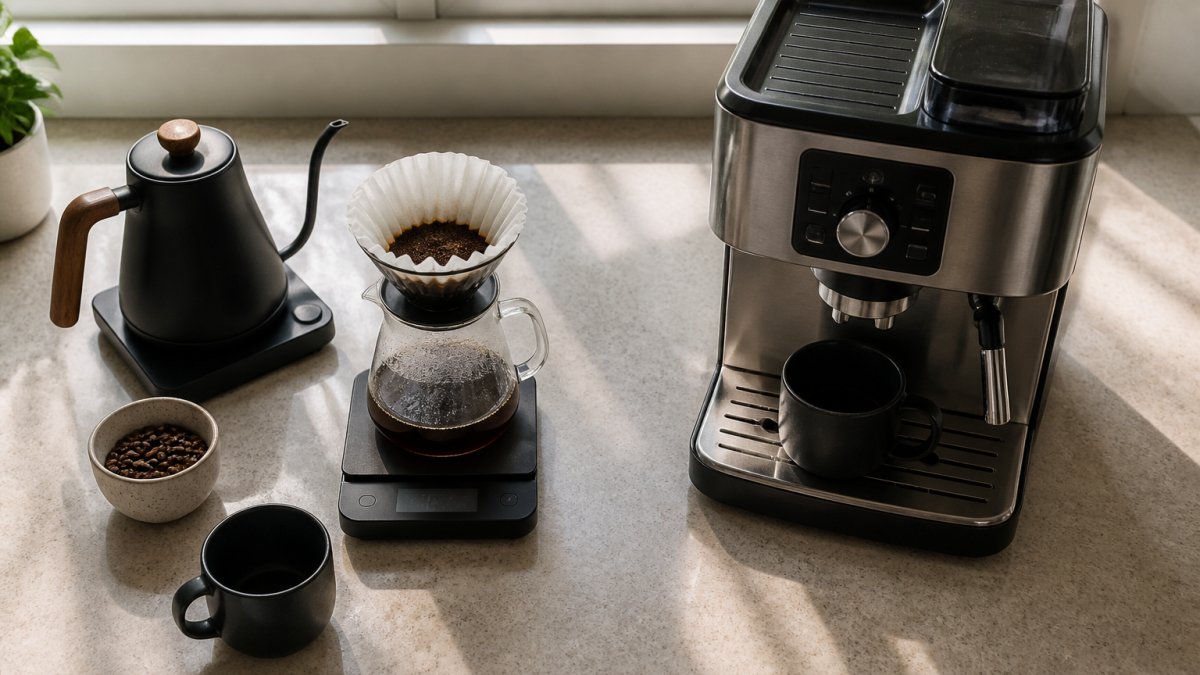
What Happens in a Manual Brew Cycle
In a manual brew, you grind freshly ground coffee, heat water to a target temperature, and pour in stages. A pour-over or French press gives you hands-on control over extraction: a finer grind and slower pour build more body, while a coarser grind and faster pass keep the cup brighter. Every variable is yours to adjust, and every variable is yours to get wrong.
What an Automatic Machine Handles for You
An automatic machine manages water temperature, brew time, and brew volume with one-touch brewing. A super-automatic machine grinds, doses, and tamps on its own; a semi-automatic machine leaves dosing and tamping to you but controls the water.
If you own a pod-compatible automatic machine, our 12 Pack Single Serve Coffee Capsules and 60 Pack Single Serve Coffee Capsules are an easy way to brew at home.


Control, Consistency, and Cup Quality: Where Each Method Wins
Consistency favors the automatic machine. Control favors the manual method. Cup quality depends more on your beans and grinder than on which method you choose, but the gap between the two methods is narrower and more mechanical than most guides admit. Here is what actually separates them.
The variables that decide the cup
Every brew, manual or automatic, comes down to five variables: dose, grind size, water temperature, agitation, and contact time. Manual brewing hands you all five. An automatic machine locks some of them and exposes others.
- Dose. A scale gives you repeatable dosing to the tenth of a gram. A super-automatic machine doses by volume or time, which drifts as beans age and the grinder retains grounds.
- Grind size. A burr grinder produces a consistent particle distribution; a blade grinder produces fines and boulders that extract unevenly. This matters more than the brew method.
- Water temperature. The Specialty Coffee Association's brewing standards put the target brew water in the 195-205°F range. A manual brewer with a variable-temperature kettle can hold that band; many drip machines cycle well below it on the hot plate.
Consistency: what "repeatable" really means
An automatic machine's consistency is real but bounded. Program it once and tomorrow's cup matches today's only if the beans, grind, and water are unchanged.
Manual brewing is consistent only when you are. A scale, a thermometer, and a written recipe turn a manual method into a repeatable one. Without those, the same pour-over can swing from sour to bitter within a week.
A controlled side-by-side taste test
Most comparisons assert a winner. A more useful approach is to control the variables and taste the difference yourself. Use the same beans, the same water, and the same ratio, and change only the brew method.
- Lock the recipe. Weigh 18 g of coffee and 300 g of water (about 1:16.7). Use the same grinder setting for both brews.
- Brew a pour-over. Bloom with 40 g of water for 30 seconds, then pour in two or three pulses to 300 g total, finishing around 2:30-3:00.
- Brew the automatic cup. Run the same dose and water volume through your machine's standard cycle.
- Taste blind. Have someone else label the cups A and B. Compare aroma, acidity, body, sweetness, and finish.
Neither method is automatically better: the automatic cup can be more consistent across several days, while the manual cup gives you more room to chase a specific flavor.
Cup quality is a grinder-and-beans problem first and a brew-method problem second. If you want to improve either method, upgrade the grinder before you upgrade the machine.
Where each method wins
| Factor | Manual Brewing | Automatic Machine |
|---|---|---|
| Control over variables | Full, hands-on control | Programmed settings |
| Consistency | Varies with skill and recipe discipline | High, repeatable within fixed inputs |
| Time per cup | 5-10 minutes | Under 2 minutes |
| Learning curve | Steep at first | Minimal |
| Cleaning | Simple rinse | Regular descaling |
| Upfront cost | Lower | Higher |
A skilled barista with a manual espresso machine can outperform many automatic machines, as Meraki's comparison of automatic and manual espresso machines notes. The reverse is also true: an automatic machine delivers reliably good results with almost no skill. The choice is a trade-off, not a universal winner.
Manual Coffee Brewing Equipment: What You Need and What It Costs
A basic manual setup costs less than most automatic machines up front. The real question is what each method costs over years, not at checkout. Here is the full picture, including the costs most guides leave out.
What a manual kit actually requires
You need a dripper or French press, a gooseneck kettle, a scale, and a burr grinder. The grinder is where you should spend the most, because grind size drives extraction more than any other factor.
Total cost of ownership, not sticker price
The sticker price is only the first line item. A fair comparison adds the grinder, filters, accessories, maintenance, repairs, and cost per cup over time.
- Grinder. Both methods need one, and grinder quality has a large effect on the cup.
- Filters. Paper filters for a pour-over or drip machine run a few cents per brew. A reusable metal or cloth filter cuts that to near zero but needs rinsing.
- Descaling and cleaning supplies. Automatic machines need periodic cleaning and descaling; manual brewers need less routine upkeep.
The most common false economy is buying a $20 blade grinder to save money while spending $18-$22 per bag on specialty beans. The grinder limits the cup more than the beans do.
12 Pack Single Serve Coffee Capsules →
Cleaning, maintenance, and durability
Manual brewing is simple to clean: rinse the dripper or press, discard the grounds, and occasionally deep-clean with a food-safe cleaner.
Automatic machines need more routine care. Automatic machines benefit from regular descaling and cleaning, so check your manufacturer's guidance for your model.
Durability favors the manual method on average. Manual brewing equipment is generally simple, and repairability for automatic machines varies by brand.
Environmental impact
Manual brewing heats only the water you need, while a reusable filter can reduce waste compared with disposable paper filters.
For cold brew fans, our Cold Brew Coffee is a dark French roast with very coarse grounds, blended specifically for cold brew and free of additives.

Pour-Over vs Drip Coffee Maker: Same Job, Different Results
Pour-over and drip coffee makers both make filter coffee, but they get there differently.
Pour-over rewards attention. You bloom the grounds, pour in slow circles, and control brew time. The result is a cleaner, more defined flavor profile.
Drip coffee makers trade some nuance for throughput. Load the basket, press start, and walk away. For households making several servings, that reliability matters.
Neither is better in the abstract.
The Coffee-to-Water Ratio for Pour-Over and Other Manual Methods
A common coffee-to-water ratio for pour-over is by weight, and small adjustments change the cup. A tighter ratio gives a stronger, heavier cup; a looser ratio leans brighter and lighter.
Weigh both the coffee and the water. Volume scoops are inconsistent, and small dosing errors swing brew strength more than most people expect. If the cup tastes sour or thin, tighten the ratio toward 1:15.
How to Make Better Coffee at Home, Whichever Method You Choose
- Buy fresh, roasted-to-order beans. Stale coffee tastes flat no matter how you brew it.
- Grind just before brewing. Freshly ground coffee preserves aroma and oils.
- Hold water temperature near 200°F. Too cool under-extracts; too hot scalds.
Watch out: skipping the grinder upgrade while buying expensive beans is the most common mistake we see. A $20 blade grinder will hold back a great bag of coffee.
Find Your Perfect Roast for Your Brewing Setup
The right roast depends on your brewing method and your taste. Our House Blend is a versatile bean you can try with either brewing method. Medium roasts suit pour-over and drip; darker roasts hold up in espresso and cold brew.
Best for: manual brewers chasing nuance and automatic-machine owners who want a reliable daily cup.
Frequently Asked Questions
Is manual coffee brewing better than using an automatic coffee maker?
Neither method makes better coffee on its own. A skilled hand brewer can pull more flavor from a bean by adjusting grind size, water temperature, and brew time, but an automatic machine delivers a reliable cup with almost no effort. The right pick depends on whether you want hands-on control or one-touch convenience. If you drink coffee every morning before work, an automatic machine may serve you better. If you enjoy the ritual, manual coffee brewing rewards the time you put in.
Which makes better-tasting coffee, pour-over or an automatic coffee maker?
A pour-over gives you more levers to pull: grind size, water temperature, pour speed, and the coffee-to-water ratio for pour-over all shape the final cup. That control can produce a brighter, more layered flavor profile when you get it right. Automatic machines trade some of that ceiling for repeatability, so every cup tastes the same. Many households keep both: a pour-over setup for weekends and an automatic machine for weekday mornings.
Is manual coffee brewing cheaper than using an automatic machine?
Upfront, yes. A dripper, filters, a kettle, and a grinder typically cost far less than a quality automatic machine. Over time the gap narrows once you factor in filters, replacement parts, and the learning curve that comes with manual coffee brewing equipment. Automatic machines carry higher purchase prices and need descaling and servicing, but they cut the daily time cost to near zero. Compare total cost over two or three years, not just the sticker price.
How long does it take to make coffee manually compared with an automatic machine?
Manual brewing keeps you at the counter for each step, while an automatic machine lets you start a brew and walk away. The real difference is attention: manual brewing keeps you at the counter, while an automatic machine lets you walk away. Busy mornings favor the machine; slow weekends favor the pour-over.
What equipment do you need for manual coffee brewing?
At minimum you need a dripper or French press, paper filters if you use a dripper, a kettle, and freshly ground coffee. A burr grinder and a digital scale make a bigger difference than any other upgrade because they control grind size and dose. A thermometer helps with water temperature, though a kettle with preset temperatures covers that. Start with the basics, then add tools as you notice what your cups are missing. Fresh beans matter more than any single piece of gear.
Picking a brewing method is really a question about how you want to spend your mornings. If you want control and are willing to learn, manual brewing rewards you. If you want a dependable cup with no fuss, an automatic machine earns its counter space. Eden's Garden Coffee roasts to order for maximum flavor and freshness, ships fast and reliably, and offers a range of beans for either setup. Get started with Eden's Garden Coffee and find the roast that makes your brewing method taste its best.
