

How to Fix Sour Coffee: Why Fresh Beans Taste Tart
Last Updated: October 28, 2026
Quick Summary
Coffee tastes sour when fresh because recently roasted beans release carbon dioxide, and that gas blocks water from pulling out the sweet compounds inside the grounds. The result is sour coffee that reads thin, bright, and sometimes sharply acidic. Rest fresh beans for 3 to 7 days before brewing to let the gas escape.
- Most of the CO2 leaves in the first 48 to 72 hours after roasting.
- Light roasts often need closer to 7 to 10 days to settle.
- Under-extracted coffee is the leading cause of a sour cup.
- Aim for water between 195 and 205°F so sweetness can extract.
- If you must brew very fresh beans, extend the bloom to 45-60 seconds.
Table of Contents
- Why Does Coffee Taste Sour When Fresh?
- The CO2 Degassing Effect on Flavor
- Roast Profile and Perceived Sourness
- Coffee Acidity vs Sourness: What's the Difference?
- Under-Extracted Coffee: The Most Common Cause
- How Long to Rest Coffee After Roasting
- How to Fix Sour Coffee: Step-by-Step Adjustments
- TDS and Refractometry: Measuring What Your Palate Tastes
- Find Your Perfect Roast at Eden's Garden Coffee
- Frequently Asked Questions
Why Does Coffee Taste Sour When Fresh?
If your fresh beans taste sharp or tart, you are not imagining it. Coffee tastes sour when fresh because recently roasted beans release carbon dioxide, and that gas blocks water from pulling out the sweet compounds inside the grounds. The result is a cup that reads thin, bright, and sometimes sharply acidic.
At Eden's Garden Coffee, we roast to order. Below, we'll show you how to fix sour coffee without throwing out a good bag of beans.
Freshness is not the problem. Freshness is the reason. Once you understand what the gas is doing, the fix takes about two minutes.
The CO2 Degassing Effect on Flavor
Roasting builds up carbon dioxide inside the bean. That gas escapes slowly over days and weeks, a process called degassing. The rate is not linear: most of the CO2 leaves in the first 48 to 72 hours, then the curve flattens into a long tail that can run two to four weeks depending on roast level and bean density.
When you brew too soon, the trapped CO2 does two things at once, and both push the cup toward sour.
First, it blocks wetting. As hot water hits the grounds, the CO2 expands and escapes as bubbles. Those bubbles coat the surface of the coffee particles and create a gas barrier between the water and the soluble compounds inside. Water cannot dissolve what it cannot touch. The sugars, Maillard reaction products, and body-building compounds stay locked in the grounds while the fast-releasing acids, citric, malic, acetic, come out first. The result is a cup that reads thin, bright, and sharply acidic.
Second, it changes what you taste. Dissolved CO2 forms carbonic acid in water, and carbonic acid reads as a faint tartness on the palate. A very fresh brew carries a small amount of this on top of the acids that extraction already released early. The two effects stack.
You can watch this happen. Pour hot water over very fresh grounds and you get a big, foamy dome, that is CO2 leaving. The same beans a week later bloom quietly. The bloom is a gas gauge, not a freshness badge.
A common mistake is blaming the roast. In practice, the bean is simply too young. Fresh coffee needs a short rest before it brews well, and the rest period is longer for light roasts because their denser cell structure holds gas longer than the porous structure of a dark roast.
This is also why stale coffee tastes flat rather than sour. Once the CO2 is gone, water reaches the grounds evenly and extraction runs to completion, sometimes too far, which is where bitterness comes from. Sourness and staleness sit at opposite ends of the same gas curve.
Roast Profile and Perceived Sourness
Roast level changes how much acidity you taste. Lighter roasts keep more of the bean's natural acids intact, so they read brighter and more tart. Darker roasts push those acids into caramel and chocolate notes.
This is where most guides stop, and it is where the real answer starts. A light roast is not defective because it tastes lively. It is doing exactly what it should. A light Blonde roast is the style most prone to sour, under-developed flavors, so try one with these adjustments in mind.
You can taste this contrast directly with our Kenya, with bright acidity and orange and lemon notes.

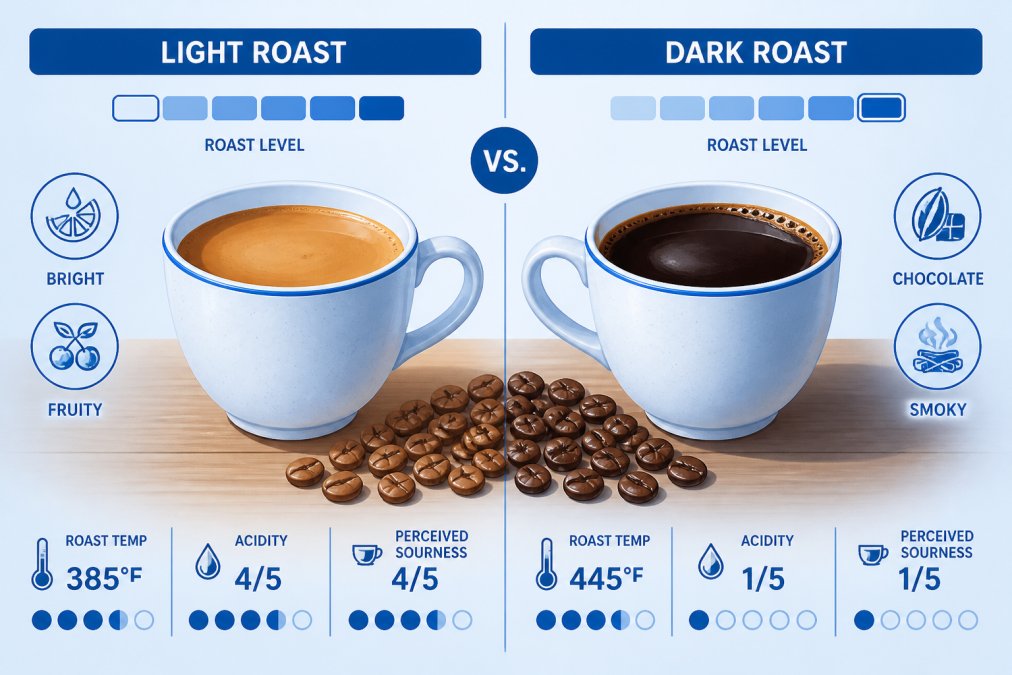
Coffee Acidity vs Sourness: What's the Difference?
Acidity is a pleasant, lively quality, like the snap in a green apple. Sourness is that same sensation gone wrong: sharp, thin, and unpleasant on the back of your tongue.
Good acidity makes coffee taste fresh and complex. Sourness tastes like unripe fruit. The line between them is thin, and it depends on your palate.
A useful test: if the finish leaves you wanting another sip, it is acidity. If your face tightens, it is sour. Our Ethiopia Natural has milk chocolate, fruity, and caramel tasting notes.

Under-Extracted Coffee: The Most Common Cause
Under-extracted coffee is the leading cause of a sour cup. Extraction is the process of water dissolving flavor from the grounds. When extraction runs short, the sweet sugars and body stay locked in the bean while the acids come out first.
That is why sour coffee often tastes weak and salty at the same time. You are tasting the early part of extraction and nothing after it.
Four brewing variables drive this:
- Grind size that is too coarse
- Water temperature that is too cool
- Brew time that is too short
- Coffee-to-water ratio with too little coffee
Fix any one of these and the cup changes. Fix all four and it transforms.
How Long to Rest Coffee After Roasting
The short answer: rest fresh beans for 3 to 7 days before brewing. Light roasts often need closer to 7 to 10 days to settle. Darker roasts degas faster and can be brewed sooner.
The bloom phase tells you where a bean stands. Pour a little hot water over the grounds and watch. A big, foamy dome means lots of CO2 is still escaping. A small, quiet bloom means the bean has rested.
Store beans in an airtight container away from light and heat. Do not refrigerate them. Moisture and odors move straight into the bag.
How to Fix Sour Coffee: Step-by-Step Adjustments
Start with grind size, then work through temperature, time, and ratio. Change one variable at a time so you know what worked.
- Grind finer. Move one notch finer and brew again. This is the fastest fix for under-extraction.
- Raise water temperature. Aim for 195 to 205°F. Cooler water cannot pull out sweetness.
- Extend brew time. Add 15 to 30 seconds to your contact time.
- Add more coffee. Tighten your coffee-to-water ratio slightly.
- Increase agitation. A gentle stir during the bloom helps water reach every ground.
Watch out: grinding too fine causes channeling, where water punches through one path and leaves the rest of the bed untouched. The cup turns sour and bitter at once.
Equipment-Specific Calibration Tips
Every brewer has its own quirks. A drip machine often runs cooler than the display claims, so check it with a thermometer. Espresso needs a finer grind and a firm, level tamp to avoid channeling. Pour-over rewards a steady, slow pour.
| Brewer | Likely Sour Cause | First Fix |
|---|---|---|
| Drip machine | Water too cool | Preheat the carafe and run a test cycle |
| French press | Grind too coarse | Grind finer, steep 4 minutes |
| Pour-over | Fast flow rate | Slow the pour, extend bloom |
| Espresso | Channeling | Level the bed, grind finer |
TDS and Refractometry: Measuring What Your Palate Tastes
Total dissolved solids, or TDS, measure how much coffee material made it into your cup. A refractometer reads this number in seconds. Higher TDS generally means more extracted flavor.
This is the angle most guides skip. Your palate is the final judge, but a refractometer turns guesswork into data. If your cup tastes sour and the TDS reads low, you have confirmed under-extraction.
Water chemistry matters here too. Water with very little mineral content extracts poorly and can push a brew toward sour. If your adjustments are not landing, test your water before you change anything else.
Find Your Perfect Roast at Eden's Garden Coffee
Sour coffee is usually a resting problem or an extraction problem, and both are solvable. Rest your beans a few days, grind a touch finer, and heat your water properly. That covers most cases.
Eden's Garden Coffee offers beans roasted to order, with a simple ordering process and reliable delivery.
Get started with Eden's Garden Coffee and taste what properly rested, well-extracted coffee actually delivers.
Frequently Asked Questions
Why does freshly roasted coffee taste sour?
Freshly roasted beans release carbon dioxide for several days after roasting. This CO2 can interfere with water contact during brewing, leading to uneven extraction and a sour taste. If your coffee still tastes sour after resting, adjust grind size or water temperature to increase extraction.
Is sour coffee under-extracted?
Yes, sourness is a classic sign of under-extracted coffee. Under-extraction happens when water doesn't pull enough flavor compounds from the grounds, often due to a coarse grind, short brew time, or water that's too cool. To fix under-extracted coffee, try a finer grind, extend the brew time by 15 to 30 seconds, or raise water temperature to 195-205°F.
How can I tell whether coffee is sour or naturally acidic?
Natural acidity feels bright and lively, like the tang in a crisp apple, and is often described with tasting notes like citrus or berry. Sourness feels sharp and unpleasant, similar to vinegar, and lingers on the palate. If the flavor makes you wince rather than refresh your mouth, it's likely sourness from under-extraction or beans that are too fresh. Eden's Garden Coffee's Kenya offers bright acidity with orange and lemon notes.
Can grind size or water temperature make coffee taste sour?
Absolutely. A grind that's too coarse lets water pass through too quickly, leaving flavors under-developed and sour. Water below 195°F also extracts less efficiently. Start with a medium-fine grind for pour-over or a fine grind for espresso, and use water between 195°F and 205°F. Change one variable at a time and taste the result before adjusting further.
